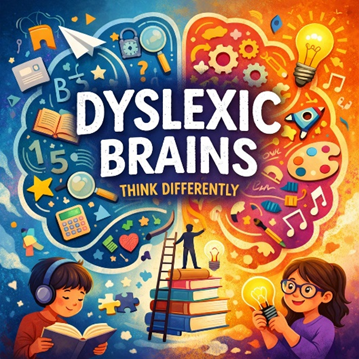
So, what is your super power? For me and my children we are dyslexic. That’s right, we are neurospicy and we see it as a super power. Research suggests that our brains are physically and functionally different to neurotypical brains and that makes us think differently. This can be an advantage when you are looking for ‘big picture, out of the box’ problem solving. But like anything, ying has its yang. You probably don’t want to rely on us for spelling, reading aloud or time management!
Dyslexia
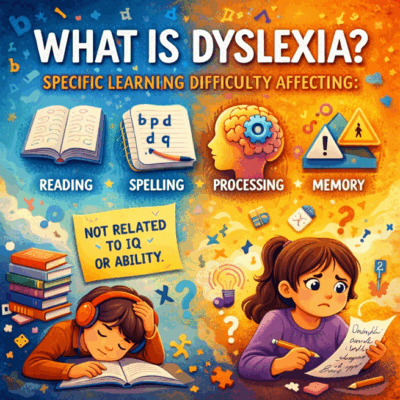
With about 6 million people in the UK living with dyslexia, it is one of the most common specific learning difficulties found in our schools. Typically, a dyslexic will have processing difficulties that affect the acquisition of reading and spelling and difficulty in phonological processing (i.e., in phonological awareness, phonological processing speed or phonological memory). It is not connected to IQ or ability but has a strong genetic link meaning dyslexia often runs in families.
So, as a teacher what do we look out for? A dyslexic student will often show greater understanding in discussions than in the written form and show a flare for problem solving and creativity. When they are reading they are likely to be slower than their peers and inaccurate because they have trouble with phonics. Their written work is likely to have spelling mistakes, which include direction confusion and letter reversal. These spelling mistakes are often inconsistent, one day they are spelt correctly and the next not. This is because the symptoms of dyslexia are worse if someone is distracted such as being tired, ill or stressed.
Dyslexics tend to work in the now; when a task is given stress builds as typically they feel they have to do the whole task now. By breaking it down into manageable chunks, maybe drip feeding tasks as they reach check points releasing the next task and this can reduce the stress.
If you suspect a student has undiagnosed dyslexia follow your school policy in alerting the SEND and pastoral teams of your concerns.
Support
Imagine you are asked to write with your non-dominate hand while the teacher is talking. You are likely to be slower than everyone else, your work doesn’t look nice compared to them, you are concentrating on writing rather than on understanding, you get left behind and feel frustrated. Welcome to a typical day in the classroom for a dyslexic. By the end of lesson five, as we have been using 25% more energy to compensate for trying to do lessons like our peers all day, we are shattered and the dyslexia is worse. So, as a teacher, reflect. Evaluate and maybe change lessons to reduce the writing load, move away from focusing on spelling, supply task management boards with reminders and time checks to help manage the workload.
Encouraging students to be independent by using coloured overlays or colorvale to reduce visual stress, uses accessibility tools e.g. highlight and read out; ask google to define/spell/show as well as presenting information using dual coding can all help with reading. When preparing your own resources choose accessible fonts which are Geometric Sans-Serif. This means that the letter ‘a’ is a simple, single-story shape, not the double-story ‘a’ with a loop.
Last year was a busy year with Educake innovating their platform by introducing new accessibility tools which includes:
· Range of fonts, colours, spacing and low contrast themes for reducing visual stress
· Different types of questions – multiple choice and free text
· Personalised revision quizzes, which adapt according to individual knowledge gaps
· A dedicated SENDCo role, giving oversight across classes and subjects
Lots of new functionality has been added to Educake to help dyslexics maximise their learning on the platform.
So, as educators, let’s recognise dyslexia not as a barrier, but as a different way of thinking. With small changes to the teaching coupled with aiding students in using accessibility tools, great learning success can follow.
You can watch Educakes’ Supporting your dyslexic students webinar:
Written by Sam Holyman, Lead Practitioner of Science across a MAT in Coventry, and formerly West Midlands ASE President. She is also the author of a number of bestselling science textbooks for Secondary Science Teaching, and a keen advocate of innovative teaching and learning.