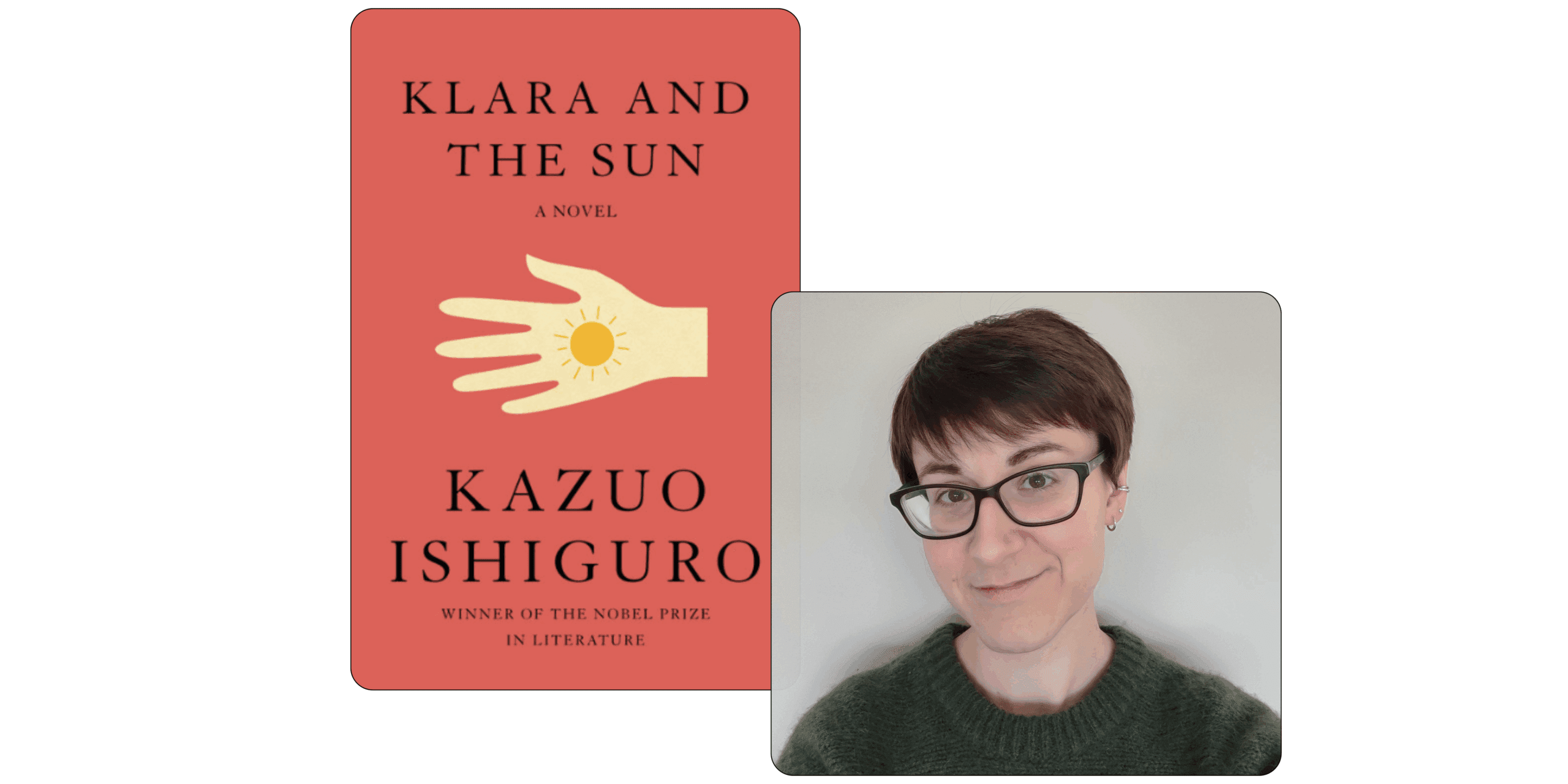
To mark the launch of Educake’s new Int. GCSE English content, we’re diving into one of the standout additions: Klara and the Sun. Educake chose Klara and the Sun with a clear purpose in mind: to introduce students to a fresh, contemporary text that broadens the literary landscape they encounter in school. English curricula often lean heavily on well established classics that are deeply loved but can be difficult to move away from.
Lauren Spence, Educake’s Humanities Commissioning Editor, believes strongly in offering variety and bringing modern voices into the classroom. Choosing a text like Ishiguro’s not only diversifies the authors that students read, but also exposes them to themes and perspectives that feel urgently relevant to the world they live in today.
Starting with immersion: Building content from the inside out
How do you take a novel as quietly profound and thematically ambitious as Klara and the Sun and turn it into classroom content that works for every student? To explore that question, we sat down with Lauren, who offered a behind the scenes look at how Educake’s literature resources are built. What emerged was a thoughtful conversation about pedagogy, accessibility, and the craft of helping students engage with big ideas through deceptively simple prose.
When work begins on a new literature text, the process always starts with immersion. Editors read closely, map the plot, trace character arcs, and identify the key themes of the text. These three strands of plot, character, and theme form the foundation of the author’s brief. Students, Lauren explains, benefit most when they know a text “inside out”, because exam questions can focus on any angle. This is especially important for a closed book exam, where students cannot rely on having the text in front of them and must instead draw on their own understanding. The goal is to prepare them not just to recall information but to apply it flexibly, no matter what the paper asks.
Choosing the moments that matter
Selecting which moments or ideas to emphasise is never straightforward, especially with a novel like Klara and the Sun, where almost every scene contributes to the emotional and philosophical weight of the story. Rather than narrowing the focus to a handful of key passages, Lauren aims for broad coverage of the plot. This helps students build a rich, adaptable understanding of the text, whether they are analysing Klara’s perspective, exploring Josie’s illness, or grappling with the novel’s unsettling vision of the future.
Before any question goes live on Educake, it must meet a few essential criteria. Clarity is non-negotiable; literature questions can easily become wordy, so the team works hard to keep phrasing sharp and direct. Accuracy is equally important, ensuring that every question remains faithful to the text. And above all, accessibility guides the process. Questions must be understandable and approachable for students of all abilities, without diluting the complexity of the ideas behind them. Lauren notes that literature brings a unique challenge compared to other subjects: the sheer amount of reading involved. Because students already face heavy textual demands, the questions themselves must not add unnecessary cognitive load.
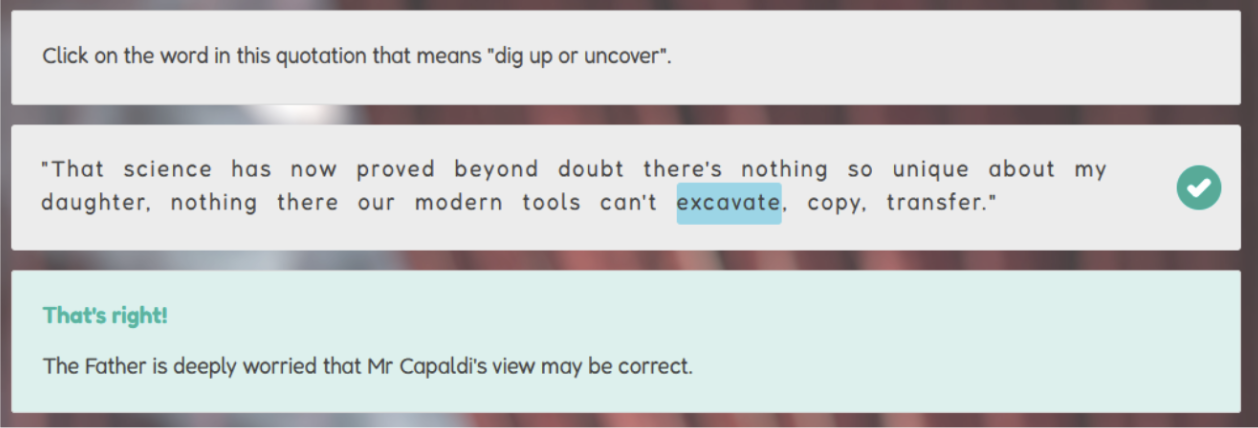
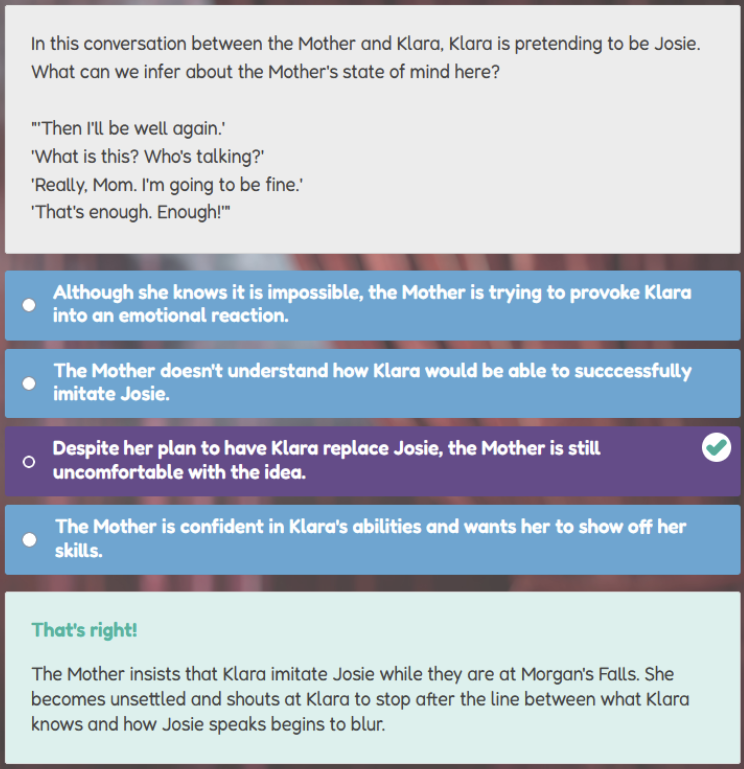
To illustrate how Educake scaffolds this understanding, here are examples of low range questions used to build confidence. Below that are mid to high range questions designed to deepen analysis.
Low range question:
Mid/high range question:
Why Klara works for every learner, including EAL students
This focus on accessibility is also why Klara and the Sun is such a strong choice for EAL learners. Ishiguro’s prose is clean, direct, and intentionally unadorned, which allows students who are still developing their English proficiency to follow the narrative with confidence. The book’s complex ideas are often described in a straightforward and literal way, making the text approachable without sacrificing depth. Even learners who are newer to English can access the novel’s universal themes of identity, belonging, technology, and humanity because the language never becomes a barrier to the ideas. It is a rare example of a set text that is linguistically gentle while still offering rich conceptual challenges.
Staying true to Ishiguro’s writing with accessibility for learners is a delicate task. The team avoids jargon and breaks down complex ideas into clear, student friendly language. The aim is not to simplify the novel but to remove barriers that might prevent students from engaging with its depth. This approach is especially important for a text like Klara and the Sun, which deals with themes that feel strikingly relevant to today’s learners. Environmental destruction, the ethics of artificial intelligence, and the question of what it means to be human all sit at the heart of the novel, making it rich ground for discussion at Int. GCSE level.
A style that supports mixed ability classrooms
One of the reasons the book works so well in mixed ability classrooms is Ishiguro’s stylistic brilliance. Klara’s voice is simple, almost childlike, which makes the prose accessible even for less confident readers. Yet beneath that simplicity lies a sophisticated narrative structure. Klara is an unreliable narrator, and much of the novel’s emotional power comes from the gap between what she perceives and what the reader understands. This duality allows teachers to stretch high attaining students while still supporting those who need more scaffolding.
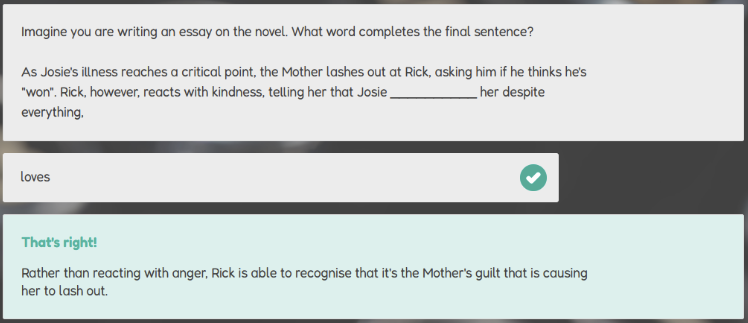
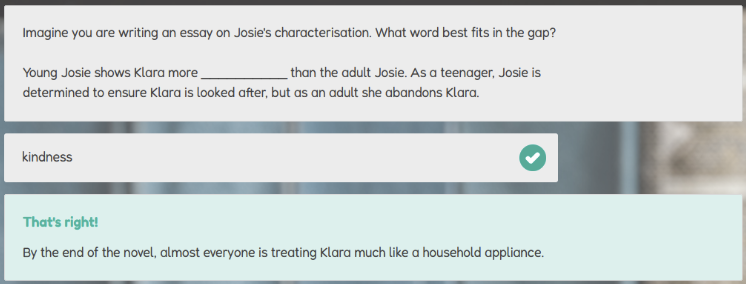
For teachers looking to challenge students further, here is an example of a question that encourages students to develop their essay-writing skills alongside deeper engagement with Ishiguro’s themes and narrative choices.
Essay style question examples:
Educake’s approach to Klara and the Sun demonstrates how thoughtful question design can open up a novel’s richness to every learner. By combining accessibility with academic rigour, Lauren and the editorial team help students engage with Ishiguro’s big ideas of technology, humanity, love, and sacrifice through prose that feels unintimidating but carries some weighty themes.

Lauren is Educake’s Humanities Commissioning Editor, responsible for our English, Humanities, and Languages content. She has worked in educational publishing since 2014 and enjoys getting stuck into a chunky project. Her spare time is filled with reading, writing, drawing, gaming, baking, walking, and cat-wrangling.